
Empty
How Albert Camus's Philosophy Saves Us Today
09/07/2026
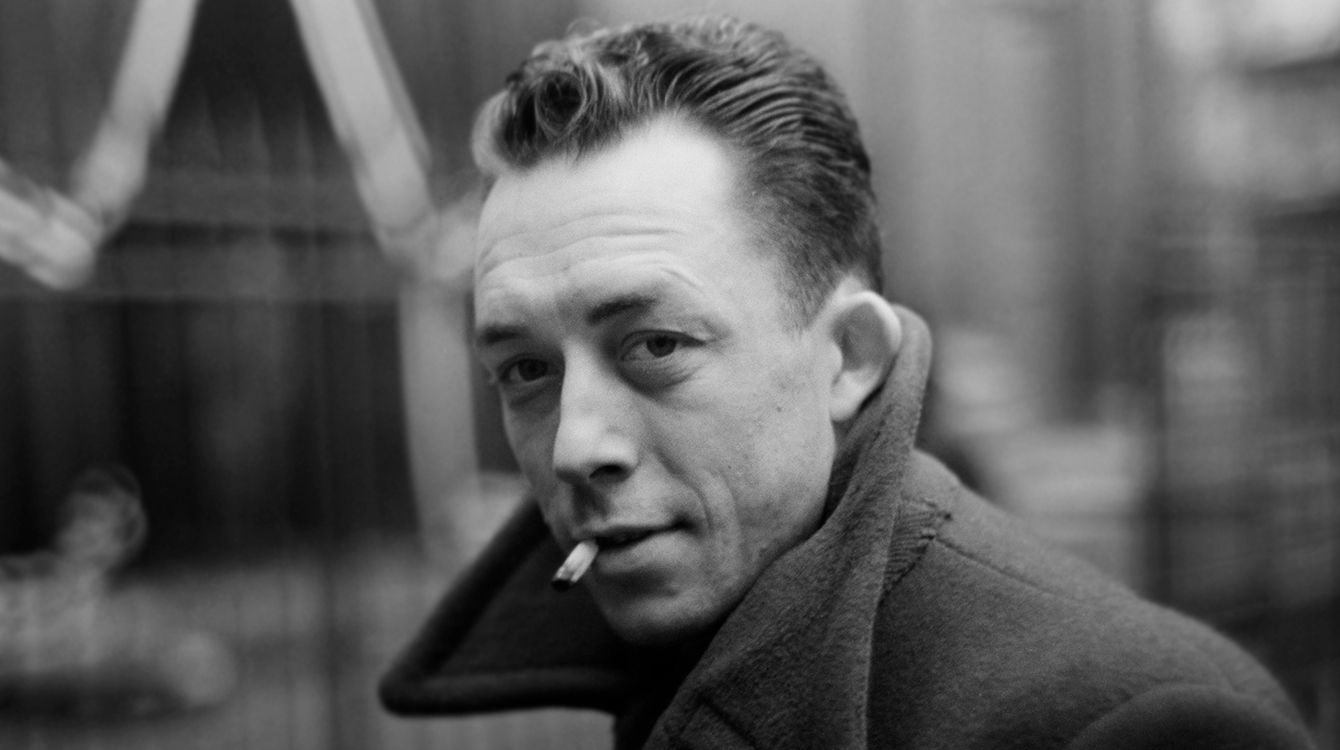
In 1957, after receiving the Nobel Prize in Literature, Albert Camus found himself completely isolated. The Parisian intellectual elite turned their backs on him, accusing him of cowardice, of betraying the cause of liberation, and of abstract humanism. His triumph turned into loneliness.
A new biography of Camus, *A Life Worth Living*, written by Robert Zaretsky, offers an opportunity to rethink the philosophy of one of the 20th century’s leading intellectuals.
The American historian structures his account of the great writer’s life around five themes: the absurd, silence, moderation, loyalty, and rebellion. As we read about Camus’s fate, we find in his philosophy points of reference that help us cope with powerlessness today. Camus’s personal journey unfolded against the backdrop of the catastrophes of his era. Born in colonial Algeria, he lost his father early in World War I; all that remained of him were “shell fragments extracted from his skull, a military cross, and a blurred photograph.” Then came his move to France, his participation in the Resistance during World War II, and, finally, the Algerian War, which caught the thinker caught between two fires.
In defiance of these catastrophes, Camus, like the hero of his essay, Sisyphus, stubbornly rolled his own boulder upward—his loyalty to the earthly sun and to living human beings.
Absurdity as a Diagnosis
For Camus, the absurd was not a purely theoretical construct: at the age of seventeen, he learned that he had tuberculosis. This came as a shock to him and marked his first encounter with the proximity of non-being. It was precisely this experience that prompted him to formulate as a philosophical problem the discord between man and the world, in which the absence of God calls into question the very meaning of existence. Death, as one of the primary manifestations of the absurd, heightens the value of earthly life—for if God is dead, nothing awaits us after we die. The central question Camus poses is: Is life, then, worth living at all?
The writer brought this problem into sharp focus in his novel *The Stranger*. For its protagonist, Meursault, the only life that makes sense is one lived in the present moment, one that is physically tangible. Meursault refuses to play social games, to lie, or to feign emotions. The only true reality for him is the total “now”: the warmth of the sun, the coolness of the sea water, the taste of a cigarette, the closeness of a woman. The protagonist of *The Stranger* is an ancient man cast into the 20th century. Albert Camus wrote in his diary: “I feel like a Greek heart in a Christian world.” In sun-drenched Algiers, he sensed the “spirit of the Mediterranean” and called himself “a man of the South.” In his essay “The Myth of Sisyphus,” Camus reinterprets the image of the ancient hero, portraying him not as a martyr but as a rebel. He saw in him a hero of the absurd: Sisyphus scorned the gods, hated death, and yearned to live. The essay’s memorable conclusion invites the reader to see Sisyphus as happy: having accepted the meaninglessness of his labor, Sisyphus continues to live with a sense of satisfaction, for he has not betrayed himself or his nature. The moment Sisyphus descends to the foot of the mountain for his boulder, he rises above his fate. His destiny belongs to him alone—in that instant, he attains absolute inner freedom.
Death is inevitable for humans, but one can escape the absurd by living in defiance of death. The Greeks believed in fate and lived for the moment. And perhaps it was illness that played no small part in Camus’s eagerness to adopt this lesson from them.
The Right to Remain Silent
The atmosphere in the impoverished home in Belcour, where Camus grew up, was steeped in silence. The household was ruled by a stern, authoritarian grandmother and a mute uncle who was a cooper. The writer’s mother, Catherine Camus, was almost always silent due to congenital hearing loss, illiteracy, and the sudden death of her husband on the front lines.
His mother’s silence became for Albert the source of that very existential anxiety from which his prose later emerged. The image of his mother runs through all his key works and becomes a reflection of a world that is silent and indifferent to humanity.
However, for Camus, silence is not merely a metaphor for an indifferent universe. When confronted with pain, the horrors of war, and the injustice of existence, human language comes up against its own limitations. Any words turn into lies, and silence becomes an act.
The Algerian War became a great trial and a personal tragedy for Camus. While leftist intellectuals extolled the revolution, turning a blind eye to the casualties among Algerian civilians, Camus chose silence, unwilling to take either side. Simone de Beauvoir declared at the time that Camus’s silence “outraged” her .
This difficult period for the writer culminated shortly after he was awarded the Nobel Prize. At a conference, a young Algerian student publicly and aggressively attacked Camus. As the leading intellectual of the era, he was expected to issue resounding manifestos and take an unambiguous stance.
Dozens of newspapers reported and widely circulated the writer’s response:
“Right now, bombs are exploding on trams in Algiers. My mother could be on one of those trams. If this is justice, then I prefer my mother.”
Many at the time considered these words “political blindness.” Left-wing newspapers in Paris called him a “colonizer with a human face” and an “intellectual deserter.” But Albert Camus’s response reflected the essence of his philosophy. There can be no such thing as abstract “justice” if it requires sacrificing an innocent life.
When words are used to justify murder, the only honest stance—and the highest form of truth—is to refuse to speak the language of violence.
Nothing in excess
For the Greeks, “hubris”—arrogance and a lack of moderation—was a grave crime against the natural order. Mediterraneans, among whom Camus counted himself, possess the art of observing limits—the ability to stop short of a dangerous line. After all, only by acknowledging one’s inherent limits and constraints can a person truly appreciate life and every moment of it.
Until the end of his days, Albert Camus had been planning a major essay entirely focused on the figure of Nemesis. His death in a car accident in 1960 cut short these plans, and the work remained in draft form. Camus insisted on reinterpreting Nemesis not as a goddess of vengeance, but of moderation. Her punishment is retribution for hubris as a disruption of the balance in this world. Nemesis symbolizes the boundary that must not be crossed in order to preserve the harmony of the cosmos, in which shadow balances light, and vice versa.
Camus views moderation as the highest virtue: the rejection of the absolute in favor of the living, vulnerable human being, and respect for the fragility and beauty of the world. The principle of moderation also formed the basis of the writer’s struggle against the death penalty. One of the few facts Camus knew about his father was the story of how he attended a public execution, believing in the fairness of the trial. But when he returned home, he could not utter a word—he was vomiting incessantly. Camus later transposed the body’s protest against legalized murder onto the pages of *The Plague*, making it a pivotal event in the life of Jean Tarrou. In his youth, the protagonist of *The Plague* was a political radical and participated in the revolutionary movement. However, Tarrou later shifts from grand ideas of reshaping the world to providing concrete help in the here and now. When Dr. Rieux asks what Tarrou hopes to achieve, he replies: “How to become a saint—that is what interests me… A saint without God—that is the only concrete problem I know of today.”
Camus saw the main danger of rebellion in its tendency to lose all sense of proportion. Rebellion that forgets its limits turns into terror: the revolutionary proclaims himself a god, and nothing restrains a god. The thinker openly states this in his essay “The Rebel.” Criticizing historical determinism and the radicalism of leftist dogmas, he vividly demonstrates how one set of oppressors is replaced by another.
The price he paid for this honesty was public vilification by his former comrades-in-arms. Jean-Paul Sartre published a scathing review of *The Rebel*, after which their relationship soured irrevocably, and Camus entered a dark and difficult period of creative stagnation and depression.
Faithfulness to the Mortal Present
In 1942, Camus wrote in his diary: perhaps the entire profound meaning of *The Odyssey* lies in the fact that its hero chose an ordinary life, full of earthly hardships, over the immortality offered to him by Calypso. “And we must, like Odysseus, choose Ithaca,” the writer concludes, “for the world bathed in light remains our first and last love.”
This choice also reflects Camus’s personal philosophy: a rejection of an ideal, sterile ‘paradise’ in favor of an imperfect but tangible present. Loving the mortal world is more difficult than praying for abstract immortality. Where God no longer acts as the guarantor of moral law, fidelity becomes the chief virtue that preserves human dignity.
Camus understood loyalty in two forms: one of them is loyalty to oneself. In an absurd world, a person must be honest with oneself—to follow one’s nature, acknowledge one’s limitations, and reject comforting lies. The second is loyalty as solidarity. Here, Camus’s almost Christian altruism is revealed, implying respect for the dignity of every human being without unnecessary conditions. During the years of the occupation, Camus risked his life in the underground, editing the Resistance’s illegal newspaper *Combat*. This was not a service to History, but an act of loyalty to specific people who had fallen on hard times.
The Greek tragedy, so beloved by the writer, differs from Christian drama in that it is more subtly constructed. While Christian drama always features a clear division between good and evil, sin and redemption, in ancient tragedy, as a rule, opposing sides clash, each with its own ethically justified truth.
Antigone becomes the central figure in Camus’s concept of loyalty. In *Antigone*, both are right: Creon, who defends the law of the state, and Antigone, who defends the law of blood and the gods. By violating Creon’s law, Antigone submits to a law far more ancient and profound—a sacred duty to her dead brother and her family. Creon thinks in terms of expediency and order, just as Sartre thinks in terms of History, thereby justifying violence. Antigone thinks in terms of loyalty and love. She faces death not for the sake of an abstract idea, but in order to remain human.
Creative Rebellion
If Sisyphus was, for Camus, a hero of the absurd, then Prometheus became the ultimate symbol of rebellion. Having diagnosed the world as “absurd,” Camus immediately proposes an existential solution.
By saying “no” to something, the rebellious individual simultaneously articulates his “yes.” For Camus, rebellion becomes a creative act. Prometheus steals fire from the gods and gives it to humanity, saying “no” to divine arbitrariness and “yes” to humanity. This is a manifestation of metaphysical rebellion against the very order of the world, against mortal fate.
In the modern world, it is a rebellion against the absurd: by demanding meaning from a silent universe and receiving no answer, a person creates that meaning through action.
Camus was strongly influenced by Nietzsche, but, unlike him, the French thinker made a different choice. In antiquity, he was drawn not to the Dionysian ecstasy of destruction and chaos, but to Apollonian order and moderation. Instead of succumbing to the nihilism that was in vogue at the time, he chose simple joy—to love earthly life in spite of its tragic meaninglessness. Having gone through the experience of personal catastrophes, wars, and total loneliness, he emerged into the light. For him, the encounter with the absurd was not a dead end, but the beginning of a journey.
The Happy Sisyphus
Albert Camus died on January 4, 1960, in a car accident. The car in which he was traveling with his publisher, Michel Gallimard, crashed into a sycamore tree at full speed. The writer was only forty-six years old. An unused train ticket was found in his coat pocket—Camus had planned to take the train but gave in to his friend’s persuasion at the last minute. In the wrecked trunk, they found the manuscript of his unfinished novel *The First Man*, caked with road dirt.
Camus’s funeral in the provincial town of Lourmarin was quiet and sparsely attended. Only a handful of his closest friends and family followed the coffin. He was buried not as a political idol, but as a neighbor, a friend, and a human being.
Camus’s philosophy offers no consolation, but it can help us survive in a world where there are no guarantees. As is well known, “man is suddenly mortal”—but according to Camus’s teachings, this is merely a reason for us to love life and its light with redoubled strength. In a world torn apart by contradictions, one can disagree with everything yet remain faithful to one’s neighbor. One can simply remain silent so as not to spread lies. And continue rolling one’s boulder, stubbornly setting the human face against the faceless face of History.
Stella Avramenko
Recent posts
- How Albert Camus's Philosophy Saves Us Today
- Irwin Welsh on old age, sober living, new romance and gun craze
- The International Literary University Uniart has opened a competitive recruitment process for the first stream
- Spirit and elementary particles
- «Odyssey», translated by Emily Wilson, became a bestseller in the United States
- Latvia will limit the import of books from Russia and Belarus
© 2026 ATMA book. All rights reserved