
Empty
Spirit and elementary particles
08/19/2026
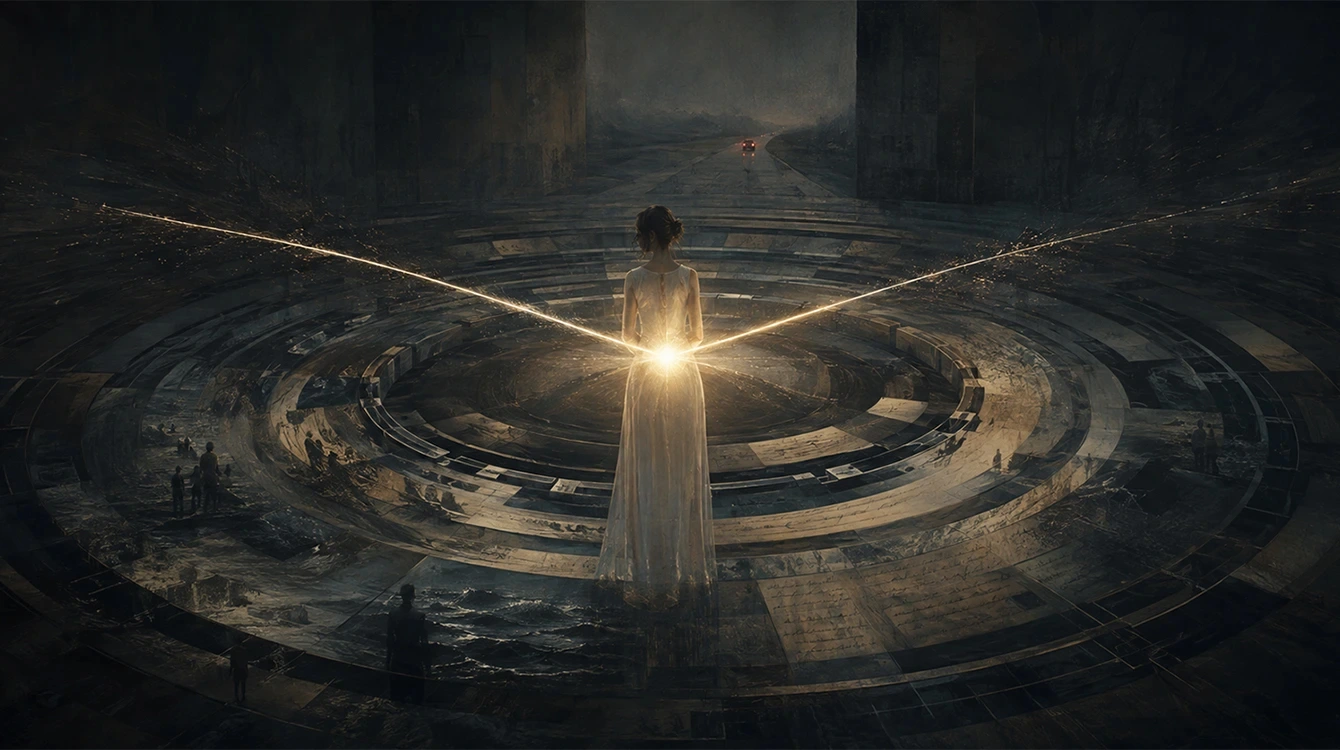
About Andrey Bychkov's book «Finally Not the End» (2026, Ibicus Press)
Fellow critics like to ask a terribly funny question: do we need such and such a book, and from this sublimity review the book. But when an Idea comes to a person, she does not ask the question whether it was needed, she just came and that’s it.
It makes sense to ask questions of a different kind: does anyone other than writers need literature today. And since we still see book bloggers of the 20+ generation on social networks, and the publishing houses are still ready, then why is the «reader gap» so clearly felt among the generation of 40-50 year olds. Which, having yesterday’s good cultural baggage, suddenly stopped reading en masse, as if until the 2010s, and who will figure out at what moment and why, and whether the Internet was to blame. This is how we can shorthand today: VKontakte advertising does not work, alarm and air raid warning. Moreover, if earlier «the fight against stress» was looked at contemptuously, as weakness and burnout from a career race, now stress will have to be looked at more closely, as a marker of the era – and through this it will be possible to understand the latest literature. I don’t know how it is everywhere, but in our provinces the topic of small talk can be who slept where their night, and everything is everyday life.
Stress and prolepsis are connected, and high-quality literature (I’m not afraid of such a word) has always been a manifestation of prolepsis. The same Zelazny described «ringing» on drawn maps, like avatars and video communication, and the Phantom Wheel – is a real foresight of AI. By the way, it spun off from its creator, in some places even putting him in an uncomfortable position and ultimately focusing only on developing itself and its own settings. Well, life-affirming. Bychkov will also have the opportunity to look into the world of stories with reader fortitude.
The opening story «On the Threshold» is a post-apocalypse in which a utopian desire for high speeds of 20th-century science fiction and a dystopian plot in the spirit of «451 degrees Fahrenheit» were sung. A policeman in a super-fast official car is forced to crush pedestrians who have violated traffic rules, it is absurd, and now, it would seem, he meets his Liberator, but there is no predictability of paths and again. Bychkov throws the dreamer under the wheels of history, while the hero – think about it – begins to want to meet further and further, and at the same time fear the evil fate that could supposedly overtake him for his atrocities, nothing oppresses him anymore. And okay, someone stopped there, but not Bychkov, who develops an encounter with animate fate into a crazy trip into the Unconscious. And, in order not to leave the reader confused, he writes simply and clearly on paper: «There is nothing left for all of us except the very last, endless, I would like to say, kiss. That we don’t need any receipts, numbers, acts, including gender ones. And that only love can save us».
And what love is, the reader would wonder, is certainly not resistance to stress. After all, it is only in popular articles that they write about insomnia and tremors, but dig deeper, and it turns out that in stress the brain discards many illusory processes: linear perception of time, remembering words, and even stops drowning out the influx of images from the Unconscious, into the vernacular of hallucinations. No, not approaching madness, but just a reaction to stress, like aggression, like many other things that we now encounter almost everyday in the world around us. And that, oddly enough, hobbies, physical labor and routine are the salvation of the mind. What is love? I will answer with the simplest words from biology: do not encroach on the place of another in the food chain, do not absorb it, do not kill it, from the point of view of living organisms. But Bychkov goes even further again, prepare to immerse yourself in the world of ancient tragedies... and particle physics, to finally get to some truth still unknown to the consciousness.
Romanella «Antigone» - don’t ask me what a Romanella is, let him explain it himself. New times require new forms, it is a free, fluid pseudo-self-analyzing narrative in which, as far as I experience this experience, the hero is both Antigone and the Higgs boson, and from a certain point of view they are one and the same. Let me explain not as a physicist: if it were not for the mentioned particle, there would be no masses in our world, accordingly, there would be no physical body and at the same time consciousness, and we would all remain ethereal ideas hovering in the endless wastelands of the Unconscious like spirits or demons.
So Bychkov places the burden of responsibility on an elementary particle for everything that happened to human civilization, and here it would be cynically possible to stop, reject and calm down «so what». But developing the idea – what if the literature of our time has already delved into introspection, has already reached the deep, and this is where the birth of some completely new idea is required. It’s as if spirituality suddenly received a connection with the material that is explained by consciousness, and, accordingly, a reversal of the ideas of spirituality from a new angle, and all this would happen plus or minus in our time? This is a grandiose revolution in human self-awareness, when instead of the greatest Mystery everything would be explained: where does spirituality come from, and the reverence of humanity before death, and friendly oaths, and everything that has only been tried before, like water with your fingers before entering the sea, but it was not possible to describe it clearly and completely due to the lack of explanation for everything.
The problem of the 21st century, perhaps, is that we somehow rested on the laurels of what had already been created, cynically clipping the wings of new omniscient discoveries for ourselves. But if you think about it, tell a person at the beginning of the 19th century about AI, about video communication – he would consider us crazy. But even then there were prerequisites – study of the material that became the basis, and dreams, dreams, broad and susceptible to the vibrations of the universe.
Returning to purely literary tenets, the fusion of the Bychkovo simulation «stream of consciousness» with ancient tragedy is interesting. It would be strange to pay attention to this if it were just interspersed inserts, like shredded salad, no, the interpenetration of genres and eras is much deeper and more interesting. If we recall the choirs of ancient tragedies, which either engage in introspection instead of characters, or savor evil fate, then all this can be found in certain parts of the novella. Scientists accelerate a particle to go against time, immerse it in memories, in the past? This is what the Antigone particle is doing, wandering between two worlds. As for other twists and turns of the plot and linguistic features, here is the madness of the Unconscious, along with shamelessness and digging into the foundations of eros and vitality – this is how all this could be perceived as an experience of the will that wandered into the Unconscious in order to bring out a certain idea, a lesson, like The Path, like ancient examples of literature from the times of epics, sublime and serious about Search, no matter how the author-physicist hides behind the imaginary frivolity of absurdity.
The funny thing is that prolepsis overtakes you here, and in the most unexpected places. In «Antigone» there will suddenly be a prophetic fuel tanker, even before the queues and the fall of Rosneft shares. And, I’m more than sure, an attentive reader will find out and compare something else after a while, because the Unconscious will not let any of the real divers go without its gifts.
And something new will emerge about the «extra» people that Bychkov mentions in his collection, using this phrase for those who need to be dealt with. Long live the theory of Russian literature, the extra man – this is not a Byronic hero, he, rather, creates game and harbors anger out of boredom and because the system provides him with this gap, morally and probabilistically. Unlike the Western Byronic hero, who is entirely a brainchild, disassembled by psychoanalysis, stretched out of time in his attempt to cause emotional pain to others, both out of revenge, and out of a perverted sense of justice, and in the rapture of the fruitlessness of this strange universal cry; but the result is still the cruelty of the environment or its indifference, which did not stop this cruelty in any way.
An extra Russian person – an unexplored being within such boundaries, because Russian literature immediately took on a broader and higher scope than Western psychoanalysis, as if prohibiting itself from dissecting itself exclusively with this instrument and insisting on some kind of individual deep spirituality, and humanism, and life experience, so that one can not judge her, but still at least realize her. Russian literature puts itself in the place of a spiritual interlocutor, and not a purely storyteller, tries on the role of a hermit-preacher telling a story, that’s what’s remarkable about it, while Western literature did not succeed so well in this pro-Eastern literature even in the chaotic literature of the twentieth century. And the Western, rather, tried to hit high notes with a description of external things, and through these materialized details to convey the spiritual. It is difficult to imagine in Russian literature an encounter with the devil or with his shadow according to Jung in one boat as a completed scene – and in the West they wrote so. So Bychkov largely absorbs the heritage of the Western literary tradition, and this also contains features of the time of confusion.
The lack of deep humanism among everyone living without exception – has long been a well-known topic in literature, but from a material point of view it has never been explained in science. So the literature collects data for further analysis. And reminds: Love.
Daria Totskaya
Recent posts
- How Albert Camus's Philosophy Saves Us Today
- Irwin Welsh on old age, sober living, new romance and gun craze
- The International Literary University Uniart has opened a competitive recruitment process for the first stream
- Spirit and elementary particles
- «Odyssey», translated by Emily Wilson, became a bestseller in the United States
- Latvia will limit the import of books from Russia and Belarus
© 2026 ATMA book. All rights reserved