
Empty
Irwin Welsh on old age, sober living, new romance and gun craze
08/20/2026
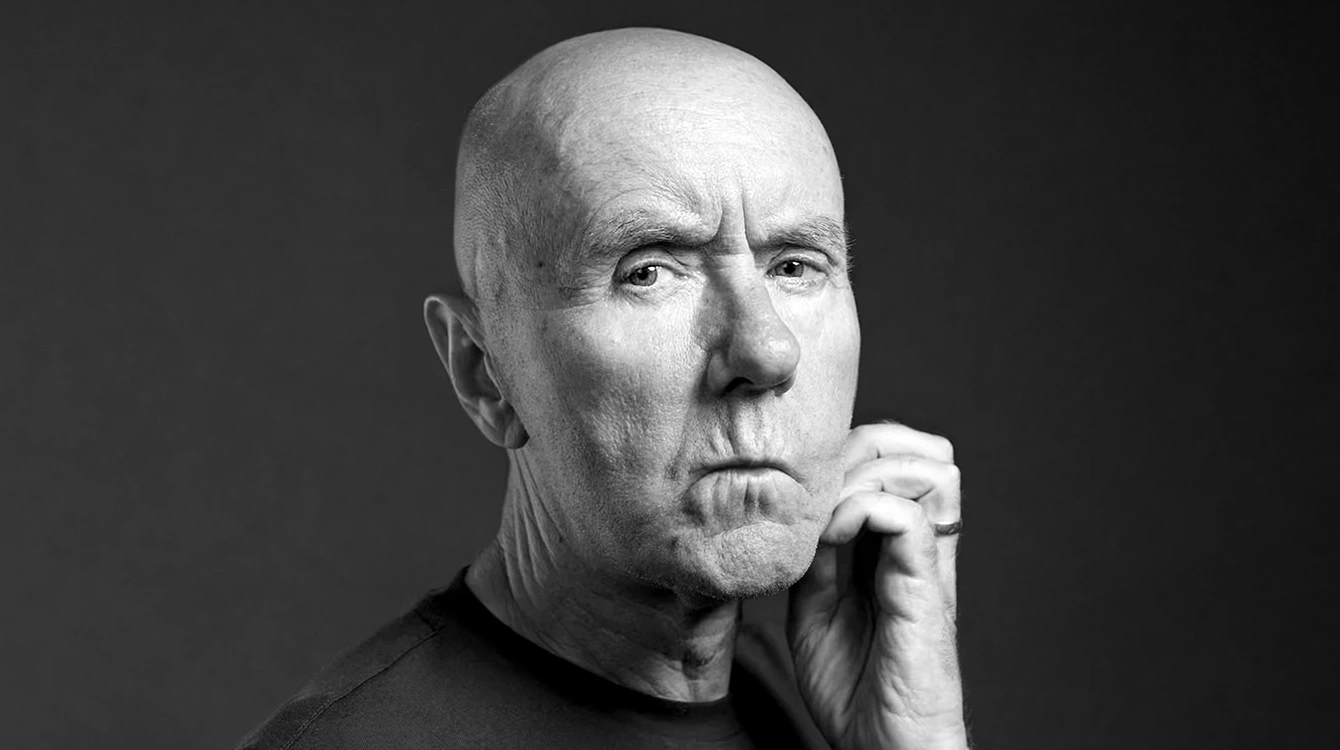
Three decades ago, a Scottish writer turned his experience of heroin addiction into a cult novel «Trainspotting». Now he discovered the joys of yoga, breathing practices and standing work. But has Welsh really achieved the kind of Zen he claims?
In fact, Irvine Welsh should be photographed in some gloomy place and always gloomy — this is what the image requires, according to him. Against a graffiti-covered wall or on the docks, wearing a low hat and certainly no smile. But in front of me sits a man with a fresh face, in shorts and a T-shirt, drinks tea and — it’s hard to imagine anything less in line with his reputation — talks about the benefits of yoga. Considering that Welsh really lived in the worlds he depicts in his books, he could look much worse. Hearing this, he laughs loudly; his eyes blaze joyfully. He clearly liked the phrase, and he repeats it as if he had just come up with a new motto for himself:
— Could look much worse!
In the more than three decades since his cult debut novel «Trainspotting» was published in 1993, Welsh has repeatedly addressed the dark side of life in his prose — and done so with humor. Drugs, clubs, alcohol, violence, psychological depression and social ill-being... He has already written seventeen novels and four collections of short stories, sold over six million books worldwide, but remains best known for his first novel. According to Welsh, «Trainspotting» gave him what most writers hope to achieve in a lifetime: a large book that captured the spirit of the times and became part of culture.
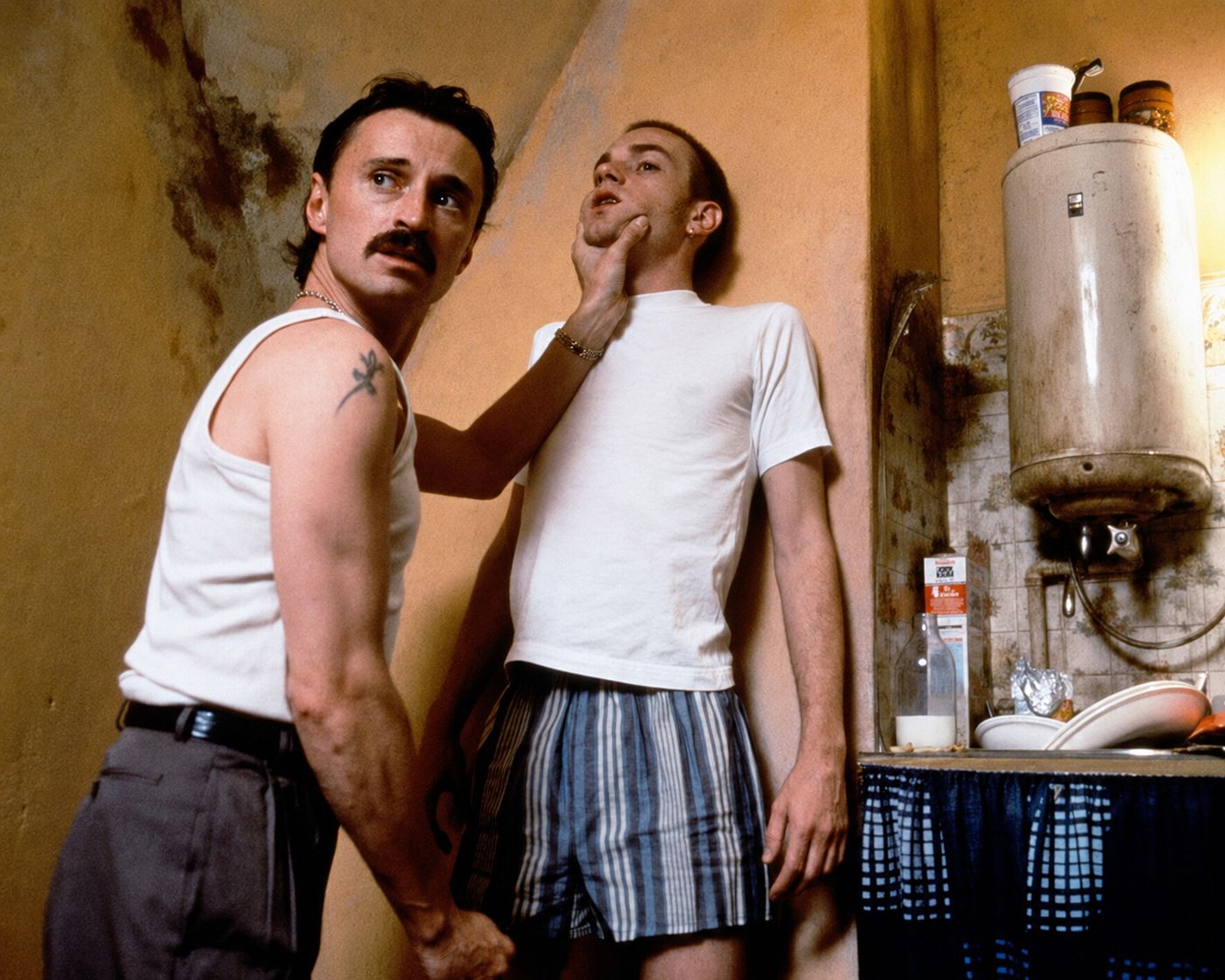 Robert Carlyle (left) and Ewan McGregor in the film «Trainspotting», 1996. Photo: TCD/Prod.DB/Alamy
Welsh's new book «Will Nothing Save Us?» (Can Nothing Save Us?) — large-scale American novel. The same mercilessly precise realism with which Edinburgh was depicted as a worker in «Trainspotting» is now directed at Trump's America. This multi-generational thriller takes place in heat-plagued Las Vegas. One of the characters says: «Everyone is unhappy. Democracy is over. Confused citizens can only help rich egomaniacs build their own principalities». Doesn't remind you of anything?
Welsh grew up in Muirhouse, north Edinburgh, but has spent much of his last twenty years in the United States. In 2005, he married American Beth Quinn—, his second, now ex-wife. The writer still has a house in Miami, as well as housing in London and Edinburgh.
—I was there when Obama was first elected, and I was there when Trump was first elected, — he says.
On the eve of Trump's victory, Welsh did not feel much anxiety. The educated women he knew who had achieved success in their profession paid almost no attention to Trump: all their thoughts were occupied by his rival.
— Clinton, — he says. — That's who was really raging. She was considered an accomplice of the worst type of man — a liberal sexual predator in sheep's clothing.
Trump remains an invisible presence in Welsh's novel: his image on a fictional television screen emanates an orange glow. Was the writer afraid of a lawsuit?
— I wanted to show real people. I didn't want to get caught up in the politics of these assholes: they already talk too much about themselves," Welsh replies.
Instead, amid the cost-of-living crisis, climate crisis, health problems, and complex family relationships, each character in the novel tries to find the moral core of their own story.
Welsh briefly returns to Leith (Edinburgh), where he was born. Photo: Murdo McLeod/The Guardian
«Wouldn't anything save us?» coming out this month, but the story of the book began a long time ago. At first, Welsh thought he was collecting material for an HBO pilot about a star DJ. It was in 2014, and he worked with his friend Calvin Harris. Welsh himself also acts as a DJ and is a co-owner of a record label. From Las Vegas DJ booths, he observed «a disgusting picture: slippery middle-aged types rubbing against young women who were lured by clubs with free entry». The project stalled, and gradually Welsh realized that the collected material could turn out to be something completely different — a novel about modern America.
He gave the manuscript to the editor and several writer friends.
—And everyone said the same thing: «This is crap!»
Welsh re-read the text.
«Damn, they're right», — he thought.
It would seem that the author of multimillion-dollar bestsellers rarely has to deal with refusals. Nevertheless, Welsh managed to sell the film rights. Watching the writers sort through his text, he turned, in his own words, «into a spy spying on his own material», and finally understood how to correct the novel.
By that time, Welsh had already seen his friend Jake Chapman's film Accelerate or Die and became acquainted with the works of accelerationists Nick Land and Sadie Plant. In its most general form, accelerationism proceeds from the fact that humanity can only come to a better future if the development of technology and capitalism accelerates. In Welsh's novel, time either quickly rushes forward, or jerkingly returns back.
— People are going through an existential crisis. Everything is moving too fast and we are no longer able to control it," he says.
So what can save us?
—We are saved by the inner insanity and unviability of the system itself, — Welsh replies, placing his cup on the table with a crash.
As proof «of unviability», he cites a decrease in interest in social networks («If you quarrel with someone on social networks, you, in fact, admit that you have no sex life»), the fading lights of Las Vegas («It’s worth Vegas sneezing —and the rest of America has already caught a cold»), «shit» everything around, the climate crisis, «radicalization of the center» in British and American politics and the Internet in general.
The Internet, he says, «was supposed to become a huge space of freedom, but turned into shackles that we put on ourselves. Now he does something to us, not to us. We follow each other, driven by our ridiculous political views and passion for poking our noses into other people's affairs...»
The plot of the novel paves the way through it all —from the Songmi massacre in Vietnam in 1968 to modern mass shootings — and, quite in the spirit of Welsh, ends in a grandiose bloodbath.
Welsh himself does not own a weapon, but once experienced a severe shock at the Lock & Load shooting club in Miami. According to him, as soon as you start shooting, this activity acquires «incredible attractiveness».
He expected to be nervous. Nothing like that.
—I turned out to be a cold-blooded killer. I really liked it. I felt the power of weapons.
And then he thought:
—What will a disadvantaged boy experience, who has no money, who cannot find a place for himself in society and hears from all sides that he is a nonentity, — and then suddenly this thing ends up in his hand...
After leaving Lock & Load, Welsh, he said, «wanted to shoot live prey».
—I wanted to shoot something moving. Track down and kill. I thought, «Fuck you, what's going on with me?» It's a drug, you know? I went there twice and then I decided, «I like it too much. We need to stop».
Welsh has long learned to monitor his own preferences, draw the line in time and not cross it again. His heroin addiction in his youth is well known — then, in his own words, «he lived, in fact, inside the Velvet Underground album». The notes and diaries of the time formed the basis of the draft «Trainspotting». Welsh tried to go through rehabilitation, but it turned out to be just an opportunity «to cleanse himself, start with a clean slate and stock up on pills again», so he decided to quit immediately and completely. Was it difficult?
 Las Vegas, where the events of Welsh's new novel unfold. Photo: Heather Diehl/Getty Images
—After I realized that I really wanted to quit, — no longer, — he answers. — The hardest thing — psychological side. If a drug is included in your emotional dictionary as a universal solution: «I can stop feeling lousy if I do this», — I have to completely rebuild my thinking.
It is not always possible to rebuild thinking, but Welsh seems to only need to make a decision to immediately implement it. He set strict rules for himself. This creates the impression of a person who is completely in control of himself, although at the same time it feels like he has to constantly suppress his own obsessive desires.
Recently, he has abandoned not only weapons, but also a sedentary lifestyle.
— Sitting — new cigarettes, — he declares.
Among demonized habits, inactivity is hardly the first to come to mind when Irwin Welsh is mentioned, but now he writes behind the counter. Last week he was traveling by train from Edinburgh to Guildford, Surrey, for a rehearsal of the musical «Trainspotting», and the next day he was in pain.
—I sat all day and felt completely broken, — he says. — I even liked it.
Did you like the pain?
—Liked that sitting turned into something that makes me feel sick. That's why I don't do that anymore.
Given the grim pleasure that the bodily protest against sitting gave him, it is not surprising that Welsh treats health care with meticulous, almost fanatical discipline.
He takes the Zapply dietary supplement, popular among boxers. Welsh himself has been boxing since childhood: his parents sent him to the section to strengthen his character. He attends classes on breathing practices — «after them everything improves: digestion, sleep» — and does Pilates and yoga.
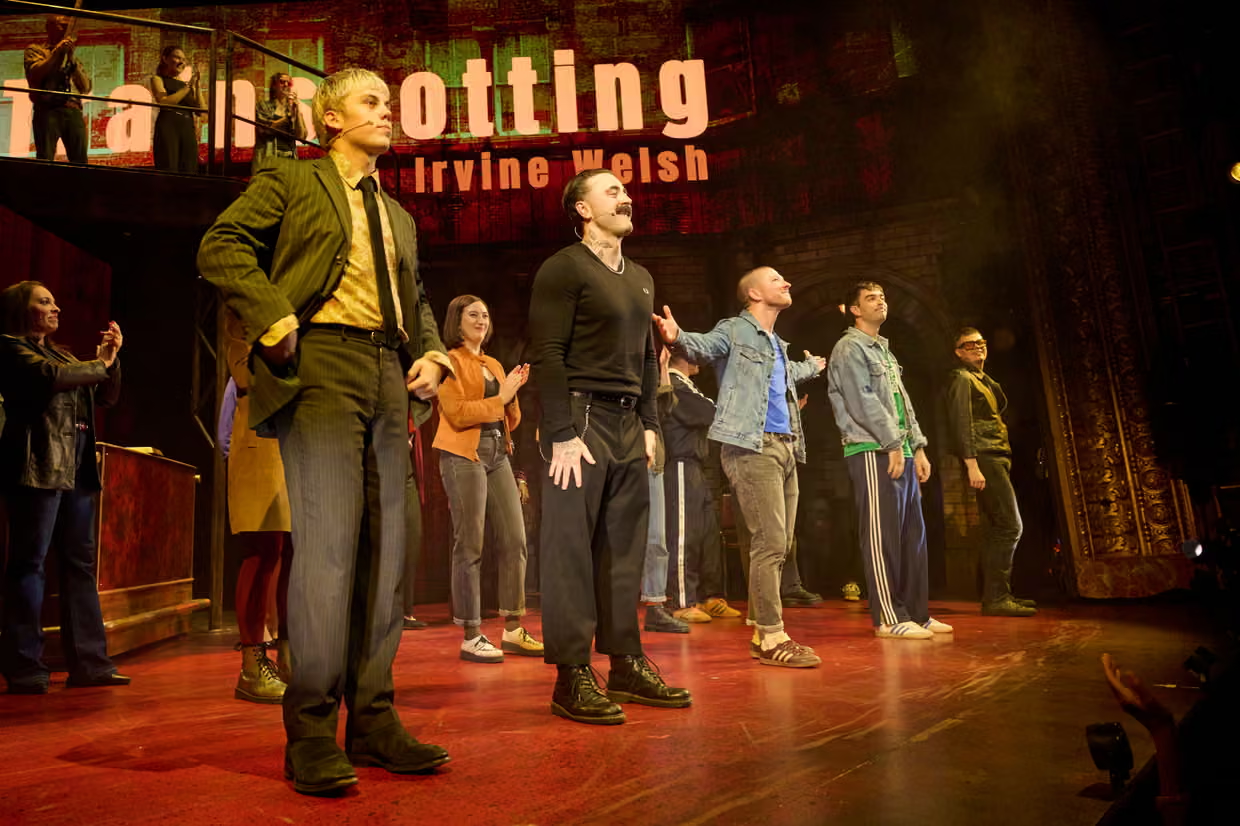 The Musical «Trainspotting» at the Theatre Royal Haymarket, London, July 2026. Photo: Alan West/Hogan Media/Shutterstock
He especially likes yin yoga, or as he calls it «yoga for lazy bastards», because you have to stay in each position for a few minutes.
—You feel your body open... Shoulders, back, hips... In general, you become calmer.
Looking at Welsh's clean-shaven head and tightly compressed lips, I can't help but imagine that under other circumstances he could become a healthy lifestyle mentor or a monk. Especially when he says:
—I have a lot more Zen in me now than I used to.
Just before Christmas, he was at the funeral of Money, bass guitarist for Primal Scream and Stone Roses. Once upon a time, Welsh would have drunk there along with the most persistent. But now he took a microdose and «flew into space» from a non-alcoholic Guinness and a cup of chocolate with mushrooms.
—And then — bam! — and you're sober. You go to bed happy and clean... And everyone else is completely upset.
Perhaps the deliberately slow yoga and the hard boundaries that Welsh sets for himself help him cope with his own irrepressibility. With his unrelenting productivity, it is noteworthy that most of all in his writing he likes to put an end to — write words «End». And he always prints them.
It is possible that Welsh is moving along his own accelerationist trajectory: the current novel is his third in three years. The next book — return to the heroes «Trainspotting» — he has already written and started another one.
— I'll stamp one after another! — he speaks cheerfully and, clenching his hands into fists, pretends to hit the keyboard.
Perhaps that's how he writes. Every January, Welsh comes to Miami and stays there for three months. In between gym and yoga, he «easily» writes ninety thousand words.
—I'm basically just playing, — he says. — Remember putting soldiers on the carpet as kids? So I'm doing the same thing.
Welsh was the only child in the family and always appreciated «the luxury of» his own room.
Sometimes his wife, actress Emma Curry, whom he married four years ago, shouts to him from below:
—You have real friends here, they came to dinner! Come down and talk to them, stop sitting with your fictional friends! You talk to people who don't exist! You're crazy!
I wonder what it was like for the only child who doesn't have children of his own to write a novel about the complex relationships between several generations of the family — although Welsh became the stepfather of three children. He was close to both parents, however — a former dockworker who later traded carpets — died when Welsh was twenty-two years old.
—He was my best friend, — says the writer.
Relations with my mother, who worked as a waitress, developed «much more violently».
—She loved me very much, but she never really wanted children.
His mother often told him:
—You were an accident, son. A wonderful accident, but still an accident.
—My mother was harsh, — Welsh says. — And she criticized my books mercilessly.
At first «Trainspotting» she hated it.
— «Pulled our dirty laundry out for everyone to see! You're disgracing me again! What a shame!» Parents didn't know much about drugs. When I was on heroin, they knew nothing, they just felt that it was something more serious than other drugs.
However, over time, the mother changed her attitude towards the novel.
—When the book started to make money, she said, «Son, I need new windows». I bought her council house, installed double-glazed windows and a new door. After that she was happy with everything. «My boy wrote a book and it became a bestseller!» — he says, imitating her Scottish reprimand, much stronger than his own. — I miss her.
She died in 2023.
— In recent years, it has begun to weaken. This put me in a strange position because her tongue had previously been razor sharp. We had a wonderful dive. And then she suddenly became slower, weaker, and it seemed to me that if I answered her in the same spirit, I was just mocking her... But if I didn’t answer, I felt that I was lenient towards her.
Eventually they found peace.
— Mom and I told each other everything. We put all our feelings on the table, talked about how we love each other, how we are friends, how much we have experienced together.
In a way, he says, this conversation happened too early:
— For the past five years, all we had to do was sit back.
In the novel, family love really turns out to be one of the main means of salvation. As for political decisions, Welsh previously said that he would like to abolish the monarchy and the House of Lords — institutions that «in the lives of most citizens no longer perform any real function». He would grant «Britain and England as much independence as they themselves want or deem necessary».
On a more personal note, Welsh is confident that as people become disillusioned with the system, they will begin to disconnect from it. He notices this shutdown in himself.
— Now the office staff publishes everything for me in X. And this thing," he says and taps the phone with the screen down, "— I started leaving the house without her. The first hour you are worried. And then you feel incredible freedom.
He does not use artificial intelligence at all — even to collect material.
According to Welsh, one of the main problems with the Internet is that it takes away context from everything — including the writer himself. At meetings in university cities «the hall is full of young people, and for some reason they expect me to be young too: “Who is this old horseradish? It can't be Irwin Welsh!”»
Yet there is something beyond age about him, although he now asks «the young team» — the children of friends and cousins — to check whether the young characters' lines sound plausible.
—Tell it to the mirror! — he replies.
Welsh has long ceased to count the years he lived. Does he even know how old he is?
— Sixty... eight? Sixty-nine? — he asks.
The Internet claims to be sixty-seven.
—After thirty, I stopped celebrating birthdays. That time I was in terrible melancholy. I thought, «I won't do this again».
It seems that aging, counting years — and perhaps growing up — has become another habit that Welsh decided to give up. But he is not afraid of what will follow life. Recently, after an experience with the psychedelic DMT, the writer broke up with atheism, which he adhered to all his life.
—Now I just don't know, — he says. — I'm even curious... You start to look at life much more optimistically.
Irwin Welsh's novel «Will Nothing Save Us?» (Can Nothing Save Us?) released August 13th by Jonathan Cape.
Paula Cocozza)
writer, publicist
Source: ‘Am I 68? 69?’ Irvine Welsh on
growing old, getting clean, bashing
out his new novel – and flirting
with guns (The Guardian)
Recent posts
- How Albert Camus's Philosophy Saves Us Today
- Irwin Welsh on old age, sober living, new romance and gun craze
- The International Literary University Uniart has opened a competitive recruitment process for the first stream
- Spirit and elementary particles
- «Odyssey», translated by Emily Wilson, became a bestseller in the United States
- Latvia will limit the import of books from Russia and Belarus
© 2026 ATMA book. All rights reserved