
Empty
The International Literary University Uniart has opened a competitive recruitment process for the first stream
08/20/2026
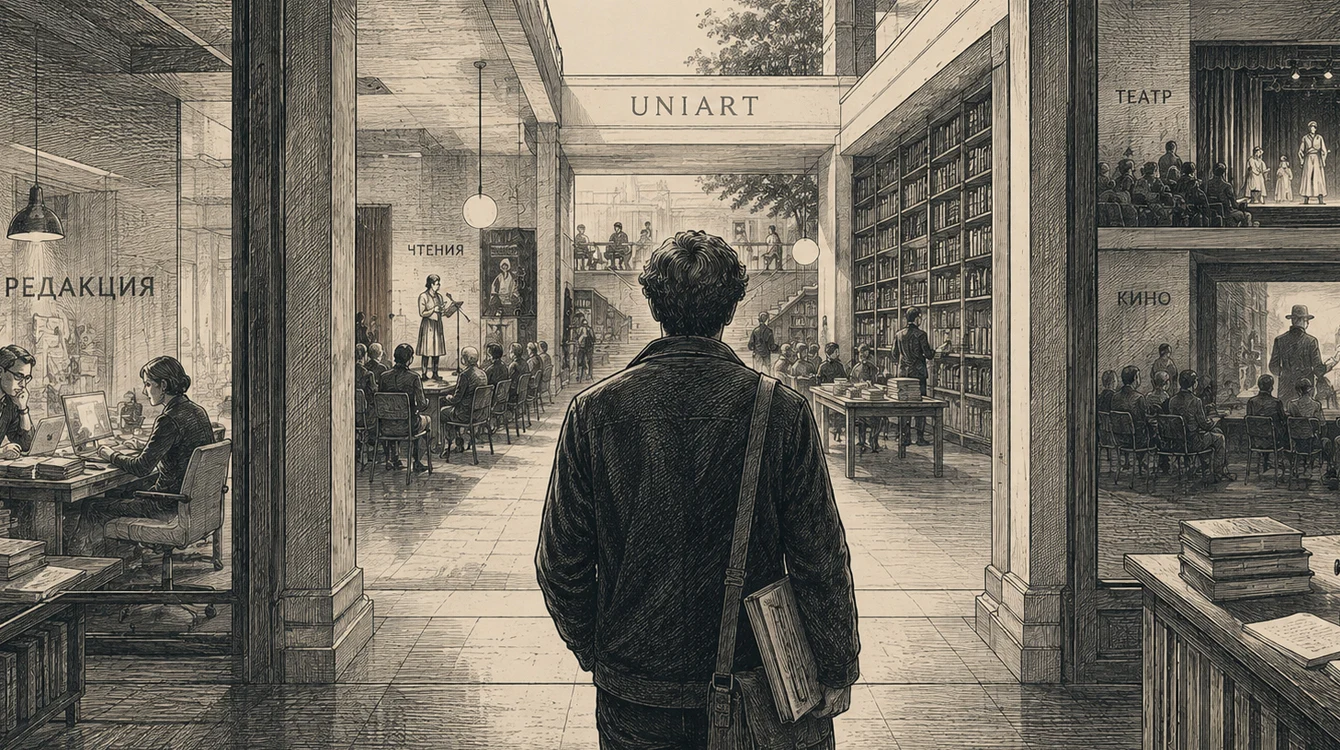
The International Literary University Uniart has begun accepting applications for the first stage of study in three areas — prose, poetry and drama. The first stream will include the groups of Sergei Gandlevsky, Yuri Krylov, Andrei Bychkov, Svetlana Volkova and Dmitry Retikh. Admission takes place through a creative competition.
Literary education has an old problem: teaching a person to work with a text does not mean teaching him to be a writer.
Outside the workshop, a professional territory begins, the structure of which a novice author often has to master on his own: editorial offices and publishing houses, literary awards, public readings, festivals, pitching, working with critics and producers. The playwright adds theater and cinema to this, and the modern poet — performance, sound, video and new media. The written text turns out to be the beginning of the process, not its completion.
The model of the Uniart International Literary University is built on the combination of literary education with the literary profession.
The university emerged within a functioning literary infrastructure. It includes the literary magazine «Atma», the Atma Publisher, the Organizing Committee of the Yuri Levitansky International Literary Prize and other projects. Editorial, publishing, premium and event work here exists regardless of the academic schedule — and at the same time becomes an environment that gradually includes students.
This is perhaps the most significant difference between the Uniart model. The student is offered to master a profession where it already exists.
He can gain editorial experience, participate in the preparation of literary projects, understand the structure of the premium process in practice, prepare texts for publication, present projects at pitching sessions, participate in readings and festivals. The interdisciplinary laboratory brings together prose writers, poets and playwrights in projects at the intersection of literature, theater, cinema, audio and digital media.
Thus, the question is «what to do with the text after it is written?» included in the educational program along with the question «how to write it better?».
Workshops
Creative workshops occupy a central place in the educational process. The group is recruited and led by an active writer, poet or playwright; he also decides on the admission of the applicant.
The first stream will be conducted by Sergei Gandlevsky and Yuri Krylov (poetry), Andrei Bychkov and Svetlana Volkova (prose), Dmitry Retikh (dramaturgy).
The work is built around regular writing and professional analysis. The mentor provides theoretical material and tasks, analyzes the students’ work, and discusses texts in a group. The workshop centres on a specific work and specific artistic challenges: composition, intonation, conflict, character, rhythm, language, dramaturgy of the scene.
This approach involves a fairly significant burden on the student himself. Uniart assumes that literary excellence is developed primarily through systematic practice.
Theory as a working tool
Second part of the programme — Fundamental Lecture Hall.
Its set of disciplines is noticeably broader than the traditional course of literary excellence: history of world literature and textual studies, philosophy and hermeneutics, psychology and psycholinguistics, mythology, cultural anthropology, theory of drama, cinema and contemporary visual art.
The logic of selection of disciplines is applied. Psychology is necessary to work with character motivation and behavior; cultural anthropology provides tools for understanding a person in various social and cultural systems; mythology and history of ideas expand the context of the text; the theory of cinema and visual art becomes especially important where a literary work goes beyond the printed page.
A separate area is related to digital technologies. Students master modern tools for research, organizing material, analyzing and creating media content, including neural network systems.
At the same time, the university draws a clear line in the use of generative AI: the literary text must remain the author’s. Works written by artificial intelligence are not accepted for the entrance competition.
Four steps
Instead of a set of independent courses, Uniart offers one sequential program.
It is divided into four stages lasting four months. The next one becomes available after the previous one is successfully completed. At the end of each level, the student receives a certificate; To obtain a diploma, you must go through the entire cycle.
This design allows you to gradually complicate tasks: from working with basic elements of text — to large works, editing, own projects and their professional presentation.
Training takes place online. Now the Uniart team brings together specialists from Russia, Armenia, Georgia, Germany, France, Great Britain, Israel and the USA, so the student’s geography is not of fundamental importance.
There is also the opportunity to combine directions. According to the current university «Rule of two chairs», a student from one workshop can enter another group —, including another faculty — with a 10% discount. The second admission also requires the consent of the mentor.
In addition to the main program, Uniart will conduct short specialized intensives with writers, publishers, editors, critics and producers. They are dedicated to specific professional tasks — for example, publishing pitching, literary awards or promoting an author.
The academic year will conclude the Uniart summer festival with readings, book presentations, theatrical performances, performances, film screenings and student interdisciplinary projects.
How the competition goes
To enter stage I, you must select a mentor and fill out an application, attaching your own literary text ranging from 5,000 to 30,000 characters. It may be a story, a selection of poems, a fragment of a novel or a play.
The text is reviewed by the head of the selected workshop. If the decision is positive, the candidate receives an offer of enrollment and details for payment.
In other words, payment follows selection rather than replacing it. The number of seats in the First Stream is limited.
Ultimately, the Uniart device can be described quite briefly. Here the student is taught to write, given the necessary humanitarian base and at the same time introduced to the mechanisms of the profession — from editorial work and publishing to awards, pitching, theater, cinema and festivals.
For a novice author, this reduces the distance between two states that appear almost identical in appearance, although in practice separated by years of trial and error: writing literature and being a participant in the literary process.
It is this distance that Uniart intends to make part of education.
Related links:
International Literary University Uniart
Description of the educational process at Uniart
Admissions Committee
Olga Ulanova. ATMA NEWS
Recent posts
- How Albert Camus's Philosophy Saves Us Today
- Irwin Welsh on old age, sober living, new romance and gun craze
- The International Literary University Uniart has opened a competitive recruitment process for the first stream
- Spirit and elementary particles
- «Odyssey», translated by Emily Wilson, became a bestseller in the United States
- Latvia will limit the import of books from Russia and Belarus
© 2026 ATMA book. All rights reserved